


Strategy sold 1,638 BTC for $104.7 million between July 27 and August 2, completing its third disclosed Bitcoin sale of 2026 and reducing its holdings to 842,138 BTC. The sale was completed at an average price of $63,957 per coin. Strategy’s remaining Bitcoin was acquired for $63.51 billion at an average price of $75,419, leaving the company with more than 4% of Bitcoin’s maximum supply. Bitcoin Proceeds Fund Dividends And STRC Buybacks Strategy allocated $52.4 million from the latest Bitcoin…









Nvidia And SK Hynix Sign Multiyear AI Memory Partnership
324 views
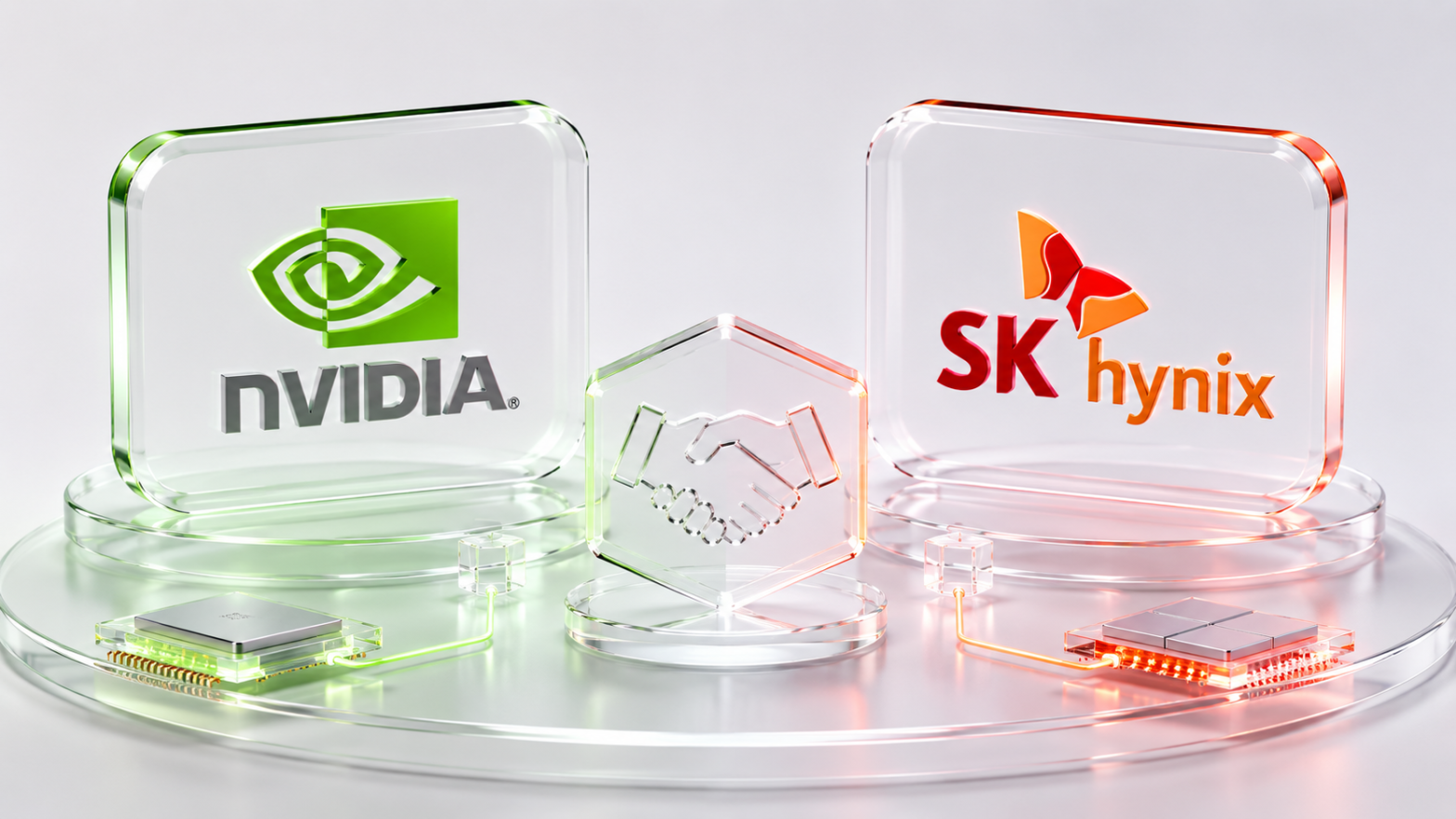

Nvidia and SK Hynix have signed a multiyear technology partnership to co-develop next-generation memory for the global AI factory buildout, deepening one of the most important supply-chain relationships in artificial intelligence hardware.
The Nvidia-SK Hynix partnership aligns advanced memory development with Nvidia’s AI infrastructure roadmap, including Vera Rubin AI supercomputers, Vera CPUs, RTX Spark-powered PCs and Jetson Thor robotic computing platforms. The companies will also use Nvidia software tools to accelerate semiconductor design, manufacturing simulation and fab automation.
The deal confirms the kind of Korea-focused AI supply announcement that investors had been watching after Jensen Huang’s June 8 Korea schedule placed Samsung, SK Hynix, HBM supply, robotics and digital twins back at the center of Nvidia’s expansion plans.
Memory Becomes A Core AI Bottleneck
The partnership shows how central memory has become to AI infrastructure. Nvidia’s GPUs and accelerators need high-bandwidth memory to feed data into large models fast enough for training, inference, agentic AI and physical AI workloads. As AI systems grow, memory bandwidth, capacity, packaging and fabrication timelines become just as important as raw compute.
SK Hynix is already one of Nvidia’s most important memory partners. The new agreement expands that role from supply into deeper co-development across Nvidia’s future platforms. Vera Rubin will sit near the top of Nvidia’s next AI roadmap, while Jetson Thor targets robotics and edge AI systems that need efficient local compute.
That makes the deal larger than a normal component-supply contract. SK Hynix is being pulled into Nvidia’s full AI stack, from data-center supercomputers to PCs and robotics. It also gives Nvidia a more direct path to shape the memory technologies needed for future platforms before those systems reach mass deployment.
AI Moves Into The Chip Factory Itself
The second part of the agreement brings Nvidia’s own AI software into semiconductor design and manufacturing.
SK Hynix will apply CUDA-X libraries and PhysicsNeMo to semiconductor simulations, technology computer-aided design workflows, computational lithography and in-house engineering codes. Those tools are aimed at reducing the time and cost of chip design, testing and manufacturing optimization.
The company will also build fab digital twins using Nvidia Omniverse libraries, OpenUSD pipelines and cuOpt. In practice, that means SK Hynix can simulate complex factory environments, optimize equipment movement, test manufacturing flows and support more autonomous fab operations before changes are made in the real world.
That is why the AI infrastructure trade is moving beyond GPUs alone. The same cycle that helped Marvell rally after Jensen Huang’s trillion-dollar AI call is spreading across networking, memory, packaging, simulation, chip design and factory automation.
Korea’s AI Supply Chain Gets More Important
The agreement also reinforces South Korea’s position inside the global AI buildout. SK Hynix and Samsung Electronics are two of the most important memory suppliers in the world, while Korean manufacturers are increasingly tied to Nvidia’s data-center, robotics and industrial AI ambitions.
That role has already reshaped regional market narratives. South Korea’s rise in global market rankings has been powered heavily by SK Hynix, Samsung and AI infrastructure demand, while investors have treated Korean memory names as direct beneficiaries of the AI factory boom.
The deal also lands during a volatile moment for chip stocks. AI-linked equities have been moving sharply as traders weigh massive infrastructure demand against valuation risk, bond yields and crowded positioning. Crypto markets have felt the same capital shift, with Bitcoin selling tied partly to risk-capital rotation toward AI mega-raises.

Btc
Bitcoin
$64.349
price
price

 0.9%
0.9%
price change

For Nvidia, the SK Hynix partnership secures a deeper memory roadmap for the next AI cycle. For SK Hynix, it strengthens its position inside Nvidia’s future platforms rather than only supplying current-generation chips. For markets, the message is clear: the AI factory race is no longer just about GPUs. It is about memory, software, simulation and automated factories built tightly around Nvidia’s platform.
Previous
South Korea Halts Stock Trading After KOSPI Plunges Over 8%
Next
Yuga Labs Rescues 68 High-Value NFTs From Flooring Protocol Exploit
Written by
Iulian Lesanu
@Iulian
1619 posts
More author posts
Strategy Sells 1,638 BTC As Saylor Defends “Never Sell” Message
Strategy sold 1,638 BTC for $104.7 million between July 27 and August 2, completing its third disclosed Bitcoin sale of 2026 and reducing its holdings to 842,138 BTC. The sale was completed at an average price of $63,957 per coin. Strategy’s remaining Bitcoin was acquired for $63.51 billion at an average price of $75,419, leaving the company with more than 4% of Bitcoin’s maximum supply. Bitcoin Proceeds Fund Dividends And STRC Buybacks Strategy allocated $52.4 million from the latest Bitcoin…
21 hours ago
Strategy Posts $8.22B Q2 Loss As Capital Plan Expands Beyond Bitcoin Purchases
Strategy reported an $8.22 billion net loss for the second quarter after Bitcoin’s decline generated a large unrealized loss across the company’s digital-asset holdings. The company recorded an $8.33 billion operating loss, including an $8.32 billion unrealized Bitcoin loss. Diluted losses reached $24.45 per common share, while net losses attributable to common shareholders totaled $8.62 billion after $400.7 million of preferred-stock dividends. Bitcoin Decline Reverses Strategy’s 2025 Gain Strategy’s second-quarter financial results marked a sharp reversal from the same period…
5 days ago
Russia Charges Telegram Founder Pavel Durov With Aiding Terrorism
Russia’s Federal Security Service charged Telegram founder Pavel Durov with aiding terrorist activity, accusing the messaging platform of failing to remove channels, chats and bots allegedly used to organise attacks inside Russia. The July 29 charge was filed under Part 1.1 of Article 205.1 of Russia’s criminal code. The FSB also placed Durov on an international wanted list, although it did not identify the legal mechanism it would use to seek his arrest abroad. Russian authorities alleged that Ukrainian intelligence…
6 days ago
KOSPI Falls 8% As July Loss Reaches 35% In Deepening Chip Rout
South Korea’s KOSPI fell 8% on Wednesday, extending its July decline to roughly 35% as another wave of selling hit the country’s largest semiconductor stocks. The benchmark dropped to 5,547.77 by midday in Seoul, its lowest level since April. The Korea Exchange activated a market-wide circuit breaker at 12:33 p.m. after an earlier sell-side sidecar suspended programme trading for five minutes. The circuit breaker requires the index to remain down at least 8% for one minute and halts trading for…
7 days ago
KOSPI Plunges Nearly 10% As Chip Rout Triggers Trading Halt
South Korea’s KOSPI plunged nearly 10% on Tuesday as investors accelerated their exit from the semiconductor stocks that powered the market’s artificial intelligence rally. The benchmark traded near 6,089, down 666 points, after falling as low as 6,031.38. The intraday low placed the index more than 35% below its June record of 9,385.59. The Korea Exchange halted trading in KOSPI-listed shares for 20 minutes at about 10:14 a.m. Korea Standard Time after the decline remained above the 8% circuit-breaker threshold.…
1 week ago
North Korea-Linked BlueNoroff Uses Fake Zoom Calls To Profile Crypto Wallets
North Korea-linked hacking group BlueNoroff is using fake Zoom and Microsoft Teams meetings to identify cryptocurrency wallets before choosing which victims receive malware. JUMPSEC recovered the source code behind an active phishing kit after its operators left JavaScript source maps exposed on live infrastructure. The files revealed an operator-controlled system combining hijacked Telegram accounts, fake meeting pages, wallet reconnaissance and malware delivery. The campaign begins when a compromised Telegram account belonging to a genuine industry contact sends a meeting invitation.…
1 week ago
Publish your own article
Guest post article. Guaranteed publishing with just a few clicks
START PUBLISHING ADVERTISE WITH USBrowse categories
Explore trending topics in the crypto community right now.
Bitcoin
Strategy Sells 1,638 BTC As Saylor Defends “Never Sell” Message
Strategy sold 1,638 BTC for $104.7 million between July 27 and August 2, completing its third disclosed Bitcoin sale of 2026 and reducing its holdings to 842,138 BTC. The sale was completed at an average price of $63,957 per coin. Strategy’s remaining Bitcoin was acquired for $63.51 billion at an average price of $75,419, leaving the company with more than 4% of Bitcoin’s maximum supply. Bitcoin Proceeds Fund Dividends And STRC Buybacks Strategy allocated $52.4 million from the latest Bitcoin...
21 hours ago  21 views
Coldcard Drain Reaches 1,367 BTC As Galaxy Finds Third Suspected Wave
Galaxy Research identified a third suspected attack wave involving Bitcoin addresses believed to have been generated by vulnerable Coldcard firmware. The latest wave drained 207.7294 BTC, lifting the estimated observed total to 1,367.05 BTC across 4,585 addresses. Galaxy valued the combined transfers at approximately $88.6 million when it published the update. Third Wave Uses Different Transaction Pattern The first two suspected waves followed similar onchain patterns, including a funnel structure that moved funds into a small group of shared collector...

3 days ago 25 views
Strategy Opens Door To Roughly $5B In Bitcoin Sales For Reserves And Buybacks
Strategy has opened the door to roughly $5 billion in potential Bitcoin sales under a balance-sheet programme covering cash reserves, preferred dividends, debt interest and securities repurchases. The figure combines up to $1.25 billion for the USD reserve, approximately $1.76 billion in current annual dividend and interest obligations and as much as $2 billion across common and preferred-stock repurchase programmes. The BTC Monetization Program has no expiration date and does not require Strategy to sell any specific amount. Bitcoin Sales...

3 days ago 28 views
Coinkite Warns Coldcard Mk3 Users As Block Traces Up To 1,083 BTC In Drains
Coinkite has warned every user who generated a seed on a Coldcard Mk3 running firmware 4.0.1 through 5.0.3 to treat the wallet as potentially exposed and migrate its bitcoin. The security advisory followed research by Block’s Bitcoin engineering and security teams, which identified weak seed-generation behavior while investigating remotely drained wallets. Coinkite’s immediate warning covers Mk3 firmware released from March 2021 onward. The company’s early analysis says Mk4, Q and Mk5 devices are not affected by the issue behind its...
5 days ago 38 views
Ethereum
Triple-A-Linked Wallets Drained Of More Than $9.7M Across Four Chains
Wallets attributed to stablecoin payments firm Triple-A were drained of more than $9.7 million across TRON, Ethereum, Polygon and Arbitrum before the assets were routed to Ethereum. Onchain analyst Specter traced the multichain outflows and linked the affected wallets to Triple-A. The stolen assets were moved through cross-chain bridges and consolidated into 5,227 ETH at an Ethereum address beginning with 0x01F8 and ending with 53b1. The transfers converged on the address after funds moved out of wallets on all four...
2 weeks ago 49 views
Arthur Hayes Wallet Adds $2.53 Million In Ether As Recent Buying Tops $5 Million
A wallet tracked as belonging to BitMEX co-founder Arthur Hayes purchased 1,332.5 ETH worth about $2.53 million early Tuesday, extending a fresh accumulation run as ether traded near $1,900. Lookonchain flagged the purchase roughly three hours after the transaction. The implied acquisition price was about $1,899 per ETH. Hayes had not publicly confirmed the trade at publication. The same tracker recorded a 1,293 ETH purchase worth $2.48 million on July 15. The two transactions added 2,625.5 ETH for approximately $5.01...

2 weeks ago 58 views
BitMine Repurchases 5.5 Million Shares As Weekly ETH Buying Slows
BitMine Immersion Technologies repurchased approximately 5.5 million common shares over the past week as the company shifted capital away from its usual pace of Ethereum accumulation. The shares were acquired at an average price of $15.6156, implying a total outlay of roughly $85.9 million. The purchases were completed under BitMine’s previously authorized $4 billion share-repurchase program. Chairman Tom Lee called the repurchases accretive to shareholder value. BMNR traded near $15.97 on Monday, slightly above the average price paid by the...

Marius Bogdan Dinu  @bdinu89
 @bdinu89
2 weeks ago 81 views
BitMine Buys 27,801 ETH As Holdings Reach 5.77M
BitMine Immersion Technologies acquired 27,801 ETH over the past week, lifting its total holdings to 5,770,038 ETH as of July 12. The position represents about 4.8% of Ethereum’s 120.7 million circulating supply, placing the company 96% of the way toward its stated goal of controlling 5% of all ETH. The latest treasury update valued the ETH position at roughly $10.5 billion using a reference price of $1,820. BitMine also held 206 BTC, $482 million in cash and marketable securities, a...
3 weeks ago 88 views
Trading
How to Get a Funded Crypto Trading Account in 2026 Step by Step
A funded crypto trading account gives a trader access to more notional capital after they prove they can follow a firm’s risk rules. The usual route starts with a paid crypto prop firm challenge that requires a profit target without breaching daily or overall loss limits. Passing is not only about making money. Drawdown control, minimum trading days and rule compliance determine whether the account survives. The evaluation fee can be lost, and crypto prop firms use different account models,...
2 weeks ago 78 views
How To Trade Tokenized Stock Perps: Leverage, Funding And Risks
Tokenized stock perps allow traders to take long or short exposure to companies, ETFs and equity indexes through crypto-native derivatives markets. Positions can use stablecoin collateral, remain open without an expiry date and continue trading when the main stock exchange is closed. The trader receives price exposure, not ownership of the referenced shares. The interface often looks identical to a crypto perpetual futures market. The risk does not. A stock-linked contract can remain active overnight, through weekends and during holidays...
Marius Bogdan Dinu
@bdinu89
@bdinu89
2 weeks ago 92 views
What Is Agentic Trading? AI Trading Agents, Crypto Automation And Risk Controls
Agentic trading is a form of market automation where an AI agent can analyze data, reason through a goal, use tools, prepare trades, and sometimes execute orders through an exchange API, wallet, smart account, broker connection, or onchain protocol. It moves the conversation beyond simple trading bots because the agent is not only following a fixed trigger. It can combine market data, user instructions, portfolio context, and approved tools before deciding what action fits the rules it has been given....
Marius Bogdan Dinu
@bdinu89
@bdinu89
4 weeks ago 155 views
What Are Crypto Data Aggregators? Price, Volume, Token Data, And Market Tracking Explained
Crypto data aggregators turn scattered market information into one usable research layer. Instead of checking separate exchanges, DEX pools, block explorers, wallet dashboards, token pages, protocol analytics, and portfolio apps, users can compare price, market capitalization, trading volume, liquidity, supply, exchange pairs, contract addresses, DeFi activity, and on-chain movement from one place. Crypto markets are fragmented across venues, chains, and token versions, so the same asset can trade on centralized exchanges, several decentralized exchanges, multiple networks, and wrapped or bridged...
1 month ago 288 views
Tech
Strategy Posts $8.22B Q2 Loss As Capital Plan Expands Beyond Bitcoin Purchases
Strategy reported an $8.22 billion net loss for the second quarter after Bitcoin’s decline generated a large unrealized loss across the company’s digital-asset holdings. The company recorded an $8.33 billion operating loss, including an $8.32 billion unrealized Bitcoin loss. Diluted losses reached $24.45 per common share, while net losses attributable to common shareholders totaled $8.62 billion after $400.7 million of preferred-stock dividends. Bitcoin Decline Reverses Strategy’s 2025 Gain Strategy’s second-quarter financial results marked a sharp reversal from the same period...
5 days ago 37 views
KOSPI Surges 15% As Korea Unveils $13.9B Strategic Fund
South Korea’s KOSPI surged about 15% to 6,376.68 by midday Friday, recovering a large portion of the losses recorded during a three-day semiconductor selloff. The index climbed as much as 16.8% to 6,531.71 earlier in the session before giving back part of the advance. Samsung Electronics rose about 21%, while SK Hynix gained 24.6%. Both stocks had climbed even further shortly after the opening bell, with Samsung reaching a 22.5% gain and SK Hynix advancing 27.7%. The rebound followed stronger...
Marius Bogdan Dinu
@bdinu89
@bdinu89
5 days ago 30 views
KOSPI Falls 8% As July Loss Reaches 35% In Deepening Chip Rout
South Korea’s KOSPI fell 8% on Wednesday, extending its July decline to roughly 35% as another wave of selling hit the country’s largest semiconductor stocks. The benchmark dropped to 5,547.77 by midday in Seoul, its lowest level since April. The Korea Exchange activated a market-wide circuit breaker at 12:33 p.m. after an earlier sell-side sidecar suspended programme trading for five minutes. The circuit breaker requires the index to remain down at least 8% for one minute and halts trading for...
7 days ago 36 views
KOSPI Plunges Nearly 10% As Chip Rout Triggers Trading Halt
South Korea’s KOSPI plunged nearly 10% on Tuesday as investors accelerated their exit from the semiconductor stocks that powered the market’s artificial intelligence rally. The benchmark traded near 6,089, down 666 points, after falling as low as 6,031.38. The intraday low placed the index more than 35% below its June record of 9,385.59. The Korea Exchange halted trading in KOSPI-listed shares for 20 minutes at about 10:14 a.m. Korea Standard Time after the decline remained above the 8% circuit-breaker threshold....
1 week ago 45 views
